The 2026 MDSGC Student Research Symposium was held on Friday, July 31, with the program beginning promptly at 8:30 a.m. EDT.
This year’s event showcased presentations by student interns and researchers representing institutions across Maryland, including: Capitol Technology University, Hagerstown Community College, Johns Hopkins University, Morgan State University, NASA, Towson University, the United States Naval Academy, University of Maryland Baltimore County, University of Maryland College Park, and University of Maryland Eastern Shore.
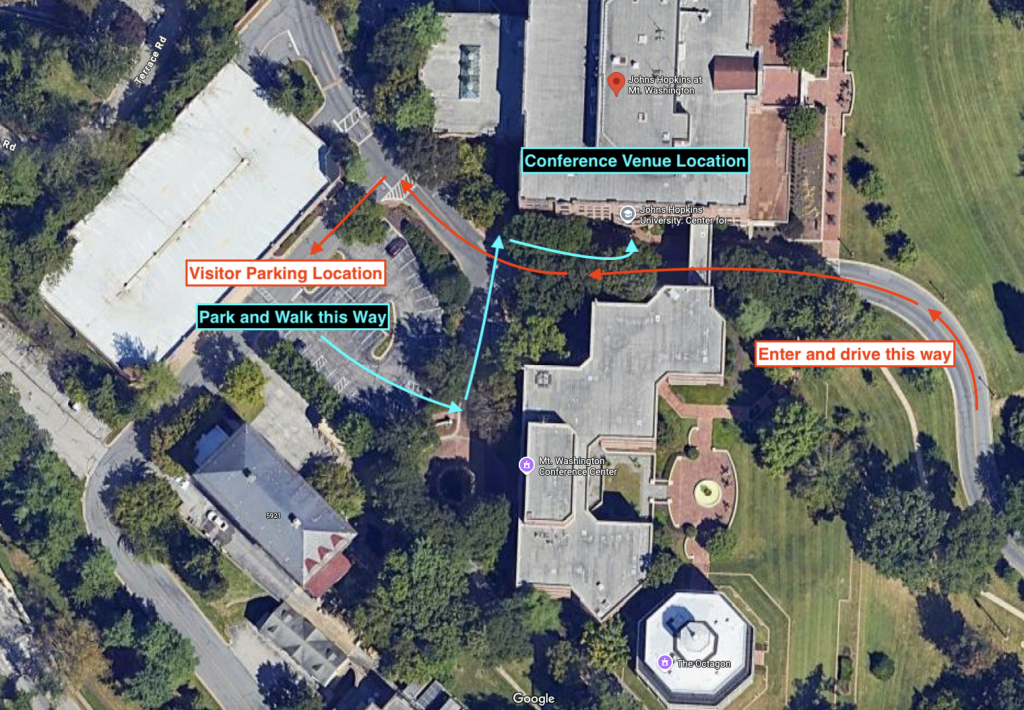
The symposium venue was the Mt. Washington Conference Center in Baltimore, MD. For GPS navigation, head for “Johns Hopkins At Mt. Washington, Smith Avenue, Baltimore, MD” (link) and park in the nearby visitor parking lot/garage. Below is an image from Google showing the relative locations of parking and the conference venue:
The event schedule and full online program follows.
2026 MDSGC Student Research Symposium Schedule
Oral Presentation Session I, 8:30 – 10:30 a.m.
The 2025-26 year was a year of innovation for the Terrapin Rocket Team. This presentation will cover a recap of the Terrapin Rocket Team’s 2026 performance at the International Rocketry Engineering Competition and a technical overview of their rocket “Zaratan”. Featuring a fully filament wound carbon fiber airframe, custom manufactured O-class motor, 5 live video cameras, an innovative active control system, and 2 axis CNC mill inside, Zaratan is the most technically advanced rocket the team has manufactured and was the team’s first rocket to break Mach 1 and greatly exceeded their previous altitude record of 11,000’.
Project Aerial Van Allen Ballket is a student engineering effort to design, build, and launch a fully instrumented “rockoon” to near-space altitudes between 70,000 and 80,000 feet. Serving as a proof-of-concept to demonstrate the viability of a balloon-launched rocket mechanism, the system lifts a modified Forte-PK 32 rocket into the stratosphere before ignition, bypassing the densest layers of the atmosphere to drastically reduce aerodynamic drag. Protected within a lightweight insulated enclosure, the flight payload relies on a custom dual-PCB avionics stack driven by a Teensy 4.1 alongside the Rockblock 9704 2B for real-time Iridium satellite telemetry, GPS tracking, and atmospheric data logging. For maximum mission safety and reliability, an independent Arduino Nano controller manages redundant altitude sensing and high-altitude ignition.
Commercial off-the-shelf (COTS) hoverboard motors provide a low-cost high-torque drivetrain option for robotic platforms such as RAVEN (Robotic Assist Vehicle for Extravehicular Navigation). However, to use these motors successfully, it is necessary to accurately characterize their motor output (i.e., torque vs. angular velocity) under actual loading conditions. This requires a specialized, reproducible testbed to evaluate performance, ensuring that the motors can satisfy the operational demands of the rover.
The NASA JPL Open Source Rover (OSR) is a low-cost, six-wheel rocker-bogie robotic platform that replicates the mobility and mechanical capabilities of planetary rovers. Powered by a Raspberry Pi and Arduino-based architecture running ROS 2, it integrates closed-loop motor control, multi-axis steering, and real-time sensor processing. An onboard Arduino-based data acquisition system automatically records geolocated, time-stamped sensor data, including GPS position, compass heading, and ambient light intensity, providing a platform for evaluating autonomous navigation, control algorithms, and sensor integration. Its modular architecture also supports the integration of advanced scientific payloads. The project team is currently exploring the installation of a NASA Goddard Space Flight Center-developed neutron spectrometer and/or a muon detector for future planetary exploration research.
NASA Langley Research Center has been a staple of modern research and hard work, encompassing more aspects than aeronautics and space travel. Both its culture and novel techniques to solve problems are widely unknown, highlighting the need for an overview of the center, which will be presented.
We worked with the USNA STEM Center this summer with the goal of providing STEM education to hundreds of students and educators through a hands-on approach to classroom learning. Our training and experiential learning at the STEM Center exposed us to a variety of topics in STEM, strengthening our communication skills and helping us become effective teachers. We created lessons designed for students of different skill levels, emphasizing the foundational aspects of computer science and programming.
GRAD-MAP is a graduate student run program at the University of Maryland, College Park, which aims to improve future prospects for those without access to research in Astronomy and Physics. In doing so, we additionally provide opportunities for graduate students to gain teaching and mentoring experience. Our method centers around undergraduate students at community colleges and institutions that do not offer STEM research internships. We seek to inform these students about careers in physics and astronomy, teach them a variety of research skills, and provide opportunities for students to gain research experience.
In this talk we will provide an overview of the GRAD-MAP framework, as well as discuss the upcoming release of Code Lab, our interactive, open-source Python lessons for scientific programming.
High energy X-rays from space are a distinct feature of compact objects, such as black holes. The matter that falls inward and surrounds a black hole is known as an accretion disk. The disk environment is proficient at reprocessing and reflecting light from the corona, a source of X-ray emission, back to our telescopes. A collection of these reflected X-rays produce a spectrum. By fitting the X-ray spectrum with reflection models, we can determine properties of the black hole’s accretion disk, such as density, ionization, and elemental abundances, among many other traits.
Current reflection models of the X-ray spectrum often apply simplifications to the ionization levels across the accretion disk, assuming an artificially smooth dependence on distance from the black hole. However, general relativistic magnetohydrodynamic (GRMHD) simulations suggest that the ionization levels in the disk are rather guided by nonuniform factors like turbulence. Motivated by GRMHD simulations, we relax this underlying assumption and assess how the resulting ionization profile directly affects the reflection spectrum.
Group Photos, 10:30 – 10:45 a.m.
Poster Session, 10:45 a.m. – 12:00 p.m. (click title for link to poster)
Verification and Validation for AI-Enabled Autonomy — Kyle Lin (UMCP/NASA GSFC)
This project examines how AI-enabled autonomous systems can be verified and validated beyond isolated model performance. It reviews several complementary methods, including formal methods, benchmarking, testing, simulation, and runtime assurance. The project also considers how evidence from these methods can be combined across model, system, and operational levels to support trustworthy autonomy.
Sodium Handling and Chemical Compatibility for Active Cooling of Fusion Components — Jocelyn Pellegrino (MSU/UMBC)
This research is to help evaluate liquid sodium’s effectiveness as a coolant for liquid lithium components. With the goal of refining property estimates and supporting a safer, more efficient reactor‑adjacent thermal design.
Naval STEM Education and Development — Savannah Schweitzer (UMCP/USNA) and Paulina Utochkin (TU/USNA)
We worked with the USNA STEM Center this summer with the goal of providing STEM education to as many kids as possible, through both direct and indirect mediums. With the training provided by the STEM Center’s staff, we were able to lead our own lessons, instruct educators, and create interactive modules for the STEM Center’s future use. Throughout the summer we were exposed to a variety of topics within science, technology, engineering and mathematics, and developed fundamental understandings of those topics to better communicate them to different age groups.
Toward Reliable Sample Collection with Legged Robots — Urjit Chakraborty (UMCP/UMES)
Planetary robots must do more than travel; they must also interact accurately with nearby samples and science targets. While wheeled rovers are proven for distances and precision, legged robots may help reach targets near large steps, loose slopes, or narrow spaces. This project develops a reliable collection system using a Unitree Go2 EDU, D1 arm, wrist-mounted RealSense D435, and YOLO26s. The robot detects and measures sample-like objects, turns when needed, stops, looks again after every movement, corrects the wrist view, and checks the target, arm solution, path, and feedback before grasping. It then lifts, verifies, sorts, or stops safely. A complete autonomous demonstration collected and sorted multiple samples without human interference.
Dyno-RAPTOR: Dynamometer Rover Assessment Platform for Torque, Output, and Response — Cory Duvall (UMES/UMCP)
Commercial off-the-shelf (COTS) hoverboard motors provide a low-cost high-torque drivetrain option for robotic platforms such as RAVEN (Robotic Assist Vehicle for Extravehicular Navigation). However, to use these motors successfully, it is necessary to accurately characterize their motor output (i.e. torque vs. angular velocity) under actual loading conditions. This requires a specialized, reproducible testbed to evaluate performance, ensuring that the motors can satisfy the operational demands of the rover.
Measuring k With a Modern-Day Coulomb Experiment — Emmitt Kuhn (TU)
This experiment reproduced Coulomb’s torsion-balance measurement using modern equipment to examine the inverse-square relationship between electrostatic force and charge separation. A PASCO ES-9070 Coulomb Balance was used with a high-voltage power supply, Faraday ice pail, and charge sensor. The torsion wire was calibrated to relate twist angle to electrostatic force, and a finite-sphere correction was applied to account for charge redistribution at short separations. Corrected and uncorrected measurements were analyzed using log-log plots, and Coulomb’s constant was calculated from the measure force, charge, and sphere separation. The experiment also examined the effects of humidity and charge loss on measurement accuracy.
Constructing a Template Baryonic Tully Fisher Relation — Michael Vaudreuil, Nicole Gorberg, Devonte Harrison (TU)
Here we present work done to refine the determination of a template Baryonic Tully-Fisher Relation (BTFR) using HI spectra of 196 supernova host galaxies using the L-Band receiver on the Green Bank Telescope and an archival sample of 21-cm spectra for a total sample of 320 galaxies with accurate, redshift-independent distance estimates. We are presenting updated best estimates of galaxy distances from supernovae and other methods, inclinations from the NASA/IPAC Extragalactic Database (NED) Local Volume Sample, and stellar masses from unWISE photometry. We use these newly compiled and calculated values to generate a preliminary template BTFR.
Evaluation of Model Precipitation for Point-Based Locations: How much is it going to rain tonight? — Alex Zielinski (UIUC/UMBC)
Gauge-adjusted and radar-based precipitation products such as MRMS and Stage IV are heavily used to verify model precipitation products, as they create a map of precipitation across the US. Their accuracy at a given location primarily depends on the data availability and quality. A recent study found MRMS and Stage IV are comparable to each other, missing about 10% of rain events and 18-44% errors in rainfall totals. NASA’s Global Precipitation Measurement Ground Validation (GPM-GV) program has been deploying Platforms for In-Situ Estimation Rainfall Systems (PIERS) at various locations across the US since late 2023. This study uses nine (9) PIERS+ sites, which include a PARSIVEL disdrometer and dual tipping bucket gauges, for 2024. The sites are primarily in the Mid Atlantic, with two sites in Texas and one in Colorado. The PARSIVEL disdrometer defined the events, event duration, and mean and maximum rainfall, while the tipping bucket gauge was the reference for rainfall amount. Unlike previous validation studies where a fixed time scale was selected, this study investigates the event rainfall. This study evaluates the performance of four models: the High Resolution Rapid Refresh (HRRR) model, the North American Mesoscale (NAM) model, the National Severe Storms Laboratory Model for Prediction Across Scales (NSSL-MPAS) model, and the National Severe Storms Laboratory Weather Research and Forecast (NSSL) model. These models all provide hourly forecasts but vary in spatial and temporal resolution. PIERS+ is not part of any operational algorithm and therefore provides independent evaluation. This study follows a farmer’s approach, meaning that it does not investigate the model production stage. Preliminary results indicate the HRRR underestimated rainfall by about 25%, an average error of 53%, and missed 25% of the events. The NAM underestimated rainfall by about 10%, with an average error of 72%, and missed 40% of the events. This work was supported by the National Science Foundation, grant number 2349543, project title: REU Site: EXPeriments in Earth and Atmospheric Science: Learning Opportunities and Research Experience (EXPLORE).
Detection of Gravitational Lensing During the 2023 Total Solar Eclipse in Exmouth, Australia — Geo Kim (TU)
Hi-definition photography of historical high definition eclipses were used to see if gravitational lensing could be detected between stars within one solar diameter of the sun. Linear algebra and spherical trigonometry were used to convert the (x,y) pixel coordinates on the imagery into right ascension and declination coordinates, which were then compared to their actual positions in the sky.
Modeling Globular Cluster Formation with PeTar N-Body Simulations — Ana Fernandez (PGCC/UMCP)
Globular clusters are old, dense stellar systems whose formation remains uncertain in the literature. Understanding the evolution of these objects from a primordial star-forming environment is essential to the field of cosmology. One possible pathway is that they formed from hierarchically compressed gas clouds in which stars were distributed through a self-similar “cluster-of-clusters” environment. In this set-up, smaller stellar subclusters merge and dynamically evolve into one larger cluster. This project used the open-source PeTar N-body code to explore this “cluster-of clusters” set-up, and how the initial number and spatial extent of subclusters influence this process. Sixteen isolated, gas-free simulations were constructed from Plummer models containing 5, 11, 23, or 50 subclusters, with half-mass radii for the initial condition of 5, 10, 20, or 40 pc. Each 500 M⊙ subcluster had an internal half-mass radius of 1 pc, and the systems were evolved for 500 Myr. Most simulations formed one dominant central stellar aggregate surrounded by a diffuse population of scattered or escaping stars. The half-mass radii generally increased with time, although several models showed strong fluctuations or periods of contraction and expansion. Larger initial parent radii often produced more extended final systems, while models with more subclusters generally developed higher central densities. These exploratory results may suggest that the initial spatial scale and total number of subclusters can influence the final size, density, and stability of clusters formed through hierarchical assembly.
Lithium Handling and Chemical Compatibility for Tritium Breeding in Nuclear Technology — Janiah Aryeetey (CTU/UMBC)
Collisions between tritium and deuterium result in fusion energy that can be used within the space exploration industry. While deuterium is relatively abundant on Earth, tritium is much rarer to find and decays faster. Instead, tritium is created via neutron bombardment within the nuclear reactor. Most materials used in the past for tritium breeding are solid lithium-containing compounds. However, it may be possible to most efficiently breed tritium by using pure liquid lithium as a plasma-facing blanket. Through a literature review, the properties of lithium as a liquid are explored, as well as any safety concerns involving working with the element, and possible methods of procurement.
Lunch and small group discussions, 12:00 – 1:00 p.m.
Oral Presentation Session II, 1:00 – 2:20 p.m.
MDSGC’s evaluator, The Goldstream Group, will share information about participant surveys. These surveys help the MDSGC report to NASA, advocate for funding, and improve the program for the future. Your feedback is very important!
Capitol Technology University 2026 Seniors in Astronautical Engineering, Data Science and Computer Science, developed the Observation & Detection Interpreted by Neural-networks (ODIN) sounding rocket payload, to explore the value of using AI-powered data analysis tools on a short duration, suborbital mission. ODIN’s Gamma-Ray spectrometers sent detections to a Jetson Nano GPU, which contained an AI model trained on Gamma-Ray sources. Detections that the model deemed “significant”, were transmitted immediately using a limited bandwidth Iridium downlink. ODIN’s primary goal was to evaluate the use of AI models as an “on board scientists” that can perform rapid, real-time data analysis, prioritizing science findings to allow highest value science to be downlinked on limited bandwidth links. Based on ODIN’s results, the team found that AI “scientists” can work quickly to assess and prioritize data for downlink, with pre-trained AI models scoring well in their ability to select the highest value science. ODIN results can be applied more broadly to sub-orbital, orbital and deep space missions, where rapid evaluation and prioritization of data is required to empower real-time decision making or transmit data using limited bandwidth downlinks.
How do you capture the sun’s energy during the day, and still use it long after sunset? This presentation highlights the development of an automated control and data acquisition system for a hybrid thermal energy storage platform, demonstrating how programming, sensors, and renewable energy technologies can work together to create smarter, more reliable energy systems. From hardware-software communication to automated temperature monitoring and data visualization, discover how these engineering principles support more sustainable technologies with applications ranging from terrestrial energy systems to future spacecraft thermal management!
This internship evaluated the growth and physiological responses of radish microgreens cultivated in Lunar and Martian regolith simulants amended with varying concentrations of horse manure. The 50:50 simulant-manure mixture exhibited the strongest plant growth and physiology performance when compared to the unamended simulants. Training with indoor and outdoor FarmBot systems, and Tower Garden provided hands-on experience in agricultural automation, precision irrigation, environmental monitoring, and vertical soilless cultivation. This training demonstrated how organic amendments, automation, and controlled environment technologies could support sustainable food production for future space exploration.
In the Newtonian theory, the force of gravity is given by f_g=GMm/r^2 where G is a universal constant of gravitation. This same constant appears in Einstein’s gravity, and to this day is the least precisely measured of all the universal constants. This presentation will detail our use of a gravitational torsion balance to measure the force of gravity and find an approximate value for G using two experimental methods. In addition to our findings this presentation will cover the difficulties in getting a precise measurement of gravity, as well as a brief history of gravitational experiments. We also compare our findings with the current accepted value of G.
We have acquired ten years’ worth of data on student math and physics grades at Towson University in order to decide how important it is to pass calculus courses before taking calculus-based physics courses that depend on them. The answer might seem obvious, but at Towson and other institutions, students are permitted to take the courses concurrently due to various real-world factors (including department size, time to degree, and financial considerations). We test four hypotheses: that completing the prerequisites sequentially rather than concurrently (1) improves average student grades in physics, (2) reduces the rate of failures and withdrawals in physics, (3) increases the chance that students will graduate with a physics degree, and (4) does not increase their time to graduation.
There has been tremendous progress in our understanding of dust in the intergalactic medium over the past few years, thanks especially to analysis of deep fields with JWST. We use this data to develop a model of IGM dust opacity as a function of redshift and test this against various observational constraints. We combine this model with standard extinction theory and LambdaCDM cosmology to derive rigorous upper and lower limits on optical depth as a function of redshift and observed wavelength. In future work, we will be able to combine this with new data on star formation rate to put what may be the first quantitative lower limits on the importance of absorption in resolving Olbers’ paradox (or why the sky is dark at night).